





How is your current physical security deployment doing?
We consistently hear about cybersecurity threats looming in our increasingly digital spaces. Yet the breaches happening in our physical spaces—breaches that directly affect our people, places, and things—are just as prominent. In fact, 23% of chief security officers rate theft of company physical property as one of the top four external threats, up there with phishing, social engineering, and the number one threat, fraud.
In today’s fast-paced world, ensuring the security of your people, places, and things requires a proactive approach to continually improve threat detection and critical incident management. Depending on your spaces, this can involve a variety of smart camera types, from fisheye lens and multi-imagers to fixed dome and bullet-lens cameras. Each plays a specific role in effectively monitoring indoor areas, entrances, exits, or parking lots and other open, outdoor spaces.
Faster than a siloed bullet camera
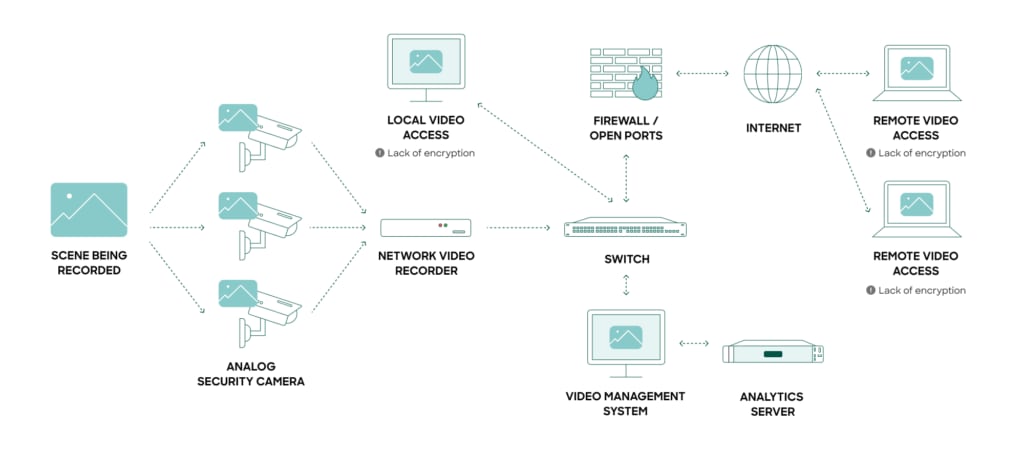
Most businesses already have some variety of physical security cameras in their spaces. However, a lack of integration can make it difficult to deploy and manage newer generations of devices. Network video recorders (NVRs) and video management systems (VMSs) are distinct tools that work together to form a traditional physical security solution. NVRs are dedicated devices that record security footage in a digital format onto a hard drive. On-premises infrastructure supports these devices, while a VMS manages video feeds from security cameras. These components may come from different vendors and require manual configurations to install. Moreover, siloed on-premises solutions may inhibit your ability to respond to an incident quickly enough.
Say a hit-and-run incident has occurred in a parking lot you manage. All you are told is that one of the cars affected was red. You have a bullet lens camera—the form factor best suited for large, open outdoor spaces—that should have captured the footage you need to assess the details of this incident.
Next, you need to locate that footage. With traditional physical security or on-premises solutions, searching through footage can take hours. Bandwidth issues could cause the video to load slowly. Once located, the resolution might not be sufficient for you to ascertain insightful details. In addition, the risk of failing is greater, as on-premises video management systems often comprise multiple components that increase the possibility of multiple points of failure. Diagnosing such issues would further delay your response.
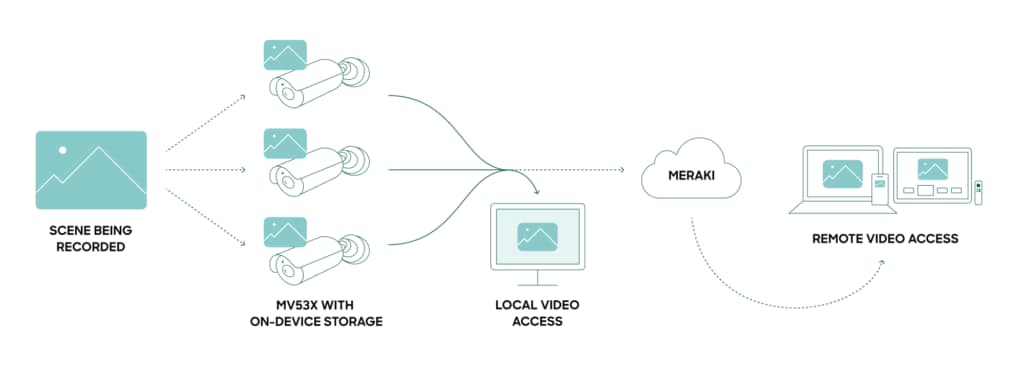
Let’s compare this scenario to one with a cloud-managed physical security solution. Adding a new bullet camera to your existing deployment would be very easy. Typically, all that’s needed to install is power and internet. With Meraki, installation is done right on the camera itself, saving bandwidth. All cameras are connected to your Meraki dashboard for simplified management.
Mounted overlooking your parking lot, a bullet camera like our MV53X can monitor areas as far as 100 feet away (approximately the length of a basketball court) with up to 4K resolution. When that hit-and-run occurs in your parking lot, you can then use our AI-powered tool, attribute search, to filter through all the recorded video to only show clips of red cars. This process is extremely easy and saves a lot of time, allowing you to focus on what comes after: providing the incident footage to the appropriate teams.
Banish blind spots with a single deployment
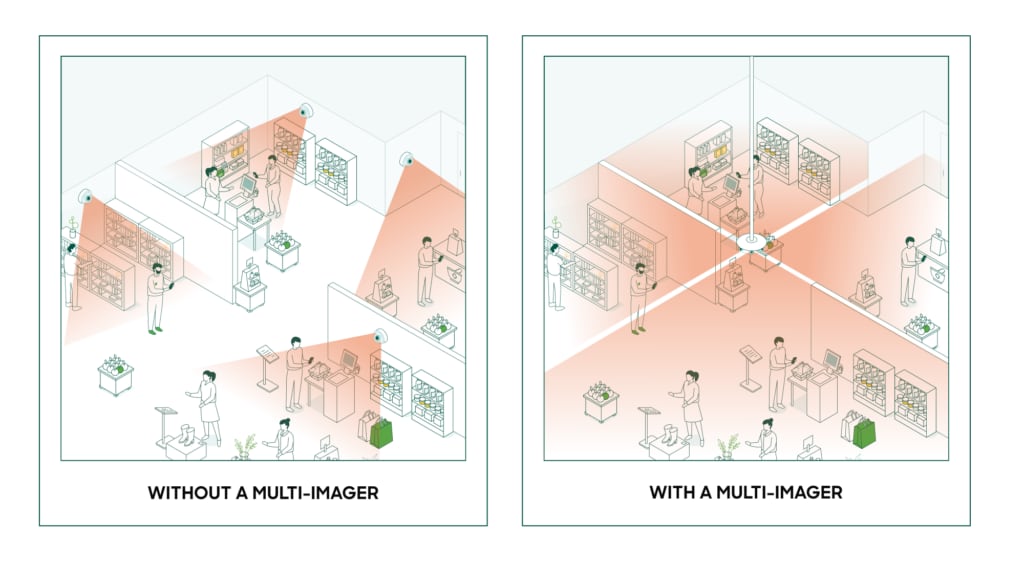
What about a different scenario? Let’s say you have been tasked with deploying a physical security solution for a retail aisle with multiple entry points. You could opt for several varifocal lens cameras to monitor these entrances and exits. However, deploying multiple cameras roughly side by side requires four separate drilled holes and four sets of arm brackets or mounting plates—in total, four distinct and complete camera installations. Additionally, the cabling required for multiple deployments can become excessive.
Once installed, you’d then have to manually set the field of view (FOV) of each camera, one by one, to capture what you are looking for and account for blind spots across your deployment. Why not just bundle that deployment process with one camera? A valuable type of form factor, where both deployment and management of the camera solution become far easier and more effective in a cloud-managed platform, is a multi-imager. Built with four individual cameras within a single camera body, it is ideal for monitoring and safeguarding areas with multiple streams of people and vehicles coming towards the camera’s FOV.
The Meraki MV84X multi-imager offers not only the capabilities you need but also the differentiating performance characteristics that make it easier to capture and locate essential footage in the case of an incident. It attaches to your network and deploys as easily as the bullet camera described above, delivering 4 TB of storage and four 5 MP sensors to monitor your space—fully eliminating blind spots. Its 1080p/24fps resolution and 120-day retention limits allow you to document a trove of visual details. And with intelligent tools such as AI-powered motion search and motion recap, the MV84X accelerates your ability to pinpoint the details that matter in an investigation.
Simplification: The real hero of your physical security story
Integrating bullet cameras, multi-imagers, or any other security camera form factors into your current deployment should be easy. Meraki takes that even further.
Our Meraki dashboard simplifies the management and configuration of your cameras, and makes it easy to monitor them, adjust user permissions, or discover when a camera has gone offline, all with just a few clicks. Real-time alerts and analytics are readily accessible, helping you make informed decisions quickly. This ease of use not only saves time but also enhances the overall efficiency of your physical security operations.
As for integration? We make it seamless, enabling you to incorporate the latest cutting-edge tech designed to protect your people and assets—without disrupting your operations. That’s a super outcome for any business, and it’s why we are so excited to introduce to our wider portfolio the MV53X bullet camera, orderable now, and the MV84X multi-imager coming in spring 2025.
To learn more, explore our physical security hub or join us at the International Security Conference and Exposition West (ISC) in April 2025!
Learn more about how to simplify your physical security solution
The post Build Physical Security Superpowers with Smart Bullet Cameras and Multi-Imagers appeared first on The Meraki Blog.