





Powering New Customer Experience Possibilities

Imagine a customer walking into your retail location and effortlessly connecting to fast, secure Wi-Fi on their phone. Instantly, their app engages them with tailored location-specific information like available coupons and new products, based on personal preferences and buying behavior. When they’re ready to check out, they skip the register and leave without the wait thanks to cashierless checkout, enjoying a truly convenient and frictionless interaction.

Creating such exceptional customer experiences is vital in today’s competitive business landscape. But behind the scenes, achieving this requires a robust network, integrated IoT devices, and an immense amount of data traveling the network in real time. The rapid advancement of AI-powered experiences—from hyper-personalization to in-store augmented reality (AR)—has opened up countless possibilities, but it has also placed a significant strain on network infrastructures (and the IT teams who support them). 

Your customer experience is only as good as your network 

To deliver exceptional experiences across every touchpoint and every location requires simplifying network operations. A Cisco cloud-managed network enables you to ditch silos and provide reliable, high-performing connectivity at any site, no matter how remote. This allows your employees to unlock productivity and collaboration, resulting in better interactions and faster problem solving for your customers.  

Simplifying network operations allows your team to shift from keeping the lights on to delivering innovative, seamless experiences your customers will appreciate.  

Powering more possibilities starts with scaling the network across locations 

To empower networking teams with more connectivity and flexibility without costly overhead, Cisco is introducing a new, versatile Meraki switching lineup: 

MS130: Cost-effective mGig access switches for remote branches and small/medium campuses 

  • An extensive product family with 8/12/24/48 port options in compact and full rack size  
  • Perfect for connecting and protecting retail point of sale setups, physical security, video conferencing/streaming, or higher bandwidth Wi-Fi deployments, all while reducing operating and deployment costs 

MS130R: First Meraki cloud-managed ruggedized PoE switch for harsh hot/cold/tight environments 

  • Extends reliable PoE power and connectivity with IP30 protection and extreme temperature (-40 °F to 158 °F) support.  
  • Ideal for outdoor cameras and access points in temperature-challenged environments like parking lots (for physical security and/or seamless curbside pickup), menu board setup,skiing resorts, and pop-up events 

Catalyst 9300L-M, C9300-M, and C9300X-M switches for campuses

  • Combine the power of the industry-leading Catalyst switching portfolio with the scalability of Meraki cloud management   
  • With the Meraki out-of-box experience, your team can maximize operational efficiency from day 0 and scale faster without compromising performance  
  • Cloud-native IOS XE software architecture offers faster boot and initialization, the ability to perform CLI show commands directly from the Meraki dashboard, and numerous other benefits for cloud-managed Catalyst switches (in public beta, fall 2024) 

Protect networks and privacy at scale with intelligent, intent-based security  

 As in the frictionless retail experience we described, the variety of applications and technologies designed to enhance on-site experiences can create a surge of devices accessing the network.   

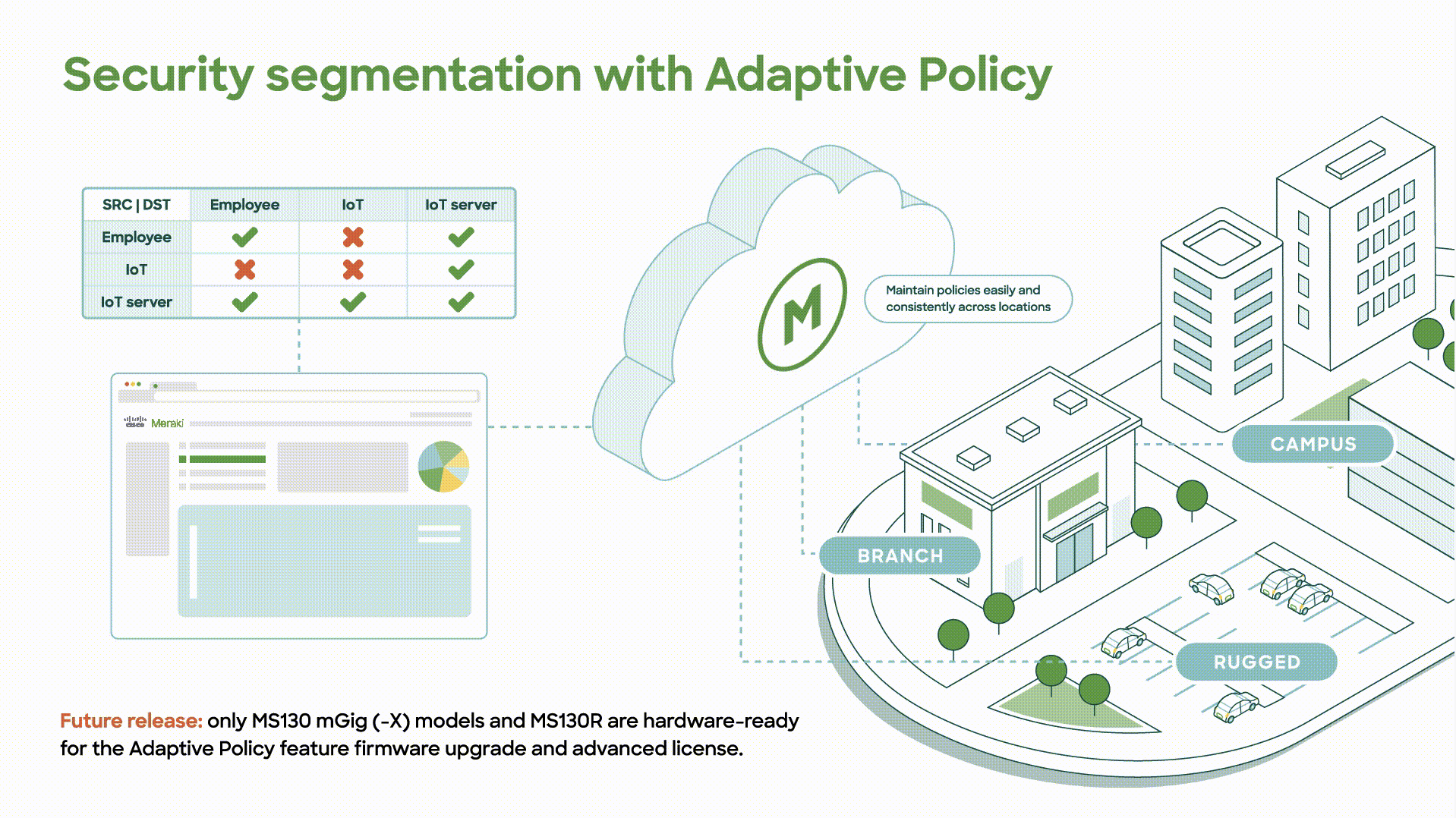
To protect data and ensure compliance from core to edge, it is crucial to have granular visibility and control over network traffic and access. Powered by Cisco TrustSec Security Group Tags (SGT) technology, Adaptive Policy dynamically identifies and enforces security policies for users, devices, and applications with network-based micro-segmentation.   

We are thrilled to extend Adaptive Policy hardware support to MS130 mGig models, MS130R, and the Catalyst 9300-M line, enabling you to safely reduce the attack surface across different environments at scale.
 

Speed innovation with simplified, smarter cloud-managed networks 

The true magic of Cisco Meraki starts even before the package arrives at your site. True zero-touch provisioning means large-scale deployments can be completed in minutes. With no dedicated on-site IT staff required, you save on time and expense.

All Cisco Meraki solutions can be effortlessly managed through the same intuitive cloud-managed dashboard. This provides your network team with deep contextualized visibility and remote management—without complexity or additional operational costs.

Learn more  

Talk to your Cisco Meraki account team today. Register for our webinar to learn more about how these new Meraki cloud-managed switches deliver enhanced connectivity, increased flexibility, and reduced overhead, empowering your organization to expand the possibilities of the customer experience. 


The post Powering New Customer Experience Possibilities appeared first on The Meraki Blog.

Is Your Network Infrastructure Ready for More IoT Devices?

From Wi-Fi 6E (and the upcoming Wi-Fi 7 technologies) to smart cameras, IoT devices are expected to grow by 50% by 2027. As organizations leverage more of these intelligent, data-generating machines to boost employee productivity and user experience, they may want to consider the impact on the network.

The associated data influx of additional IoT devices could lead to network congestion and slow response times, affecting the performance and reliability of both the network and the IoT devices it supports. Moreover, IoT devices can be susceptible to cyberattacks. Is your network infrastructure ready to handle the expected IoT growth?

Imagine investing in interactive whiteboards to enhance employee collaborations, only to experience network congestion causing delays in sharing and saving content. This would lead to frustrated employees and upset clients.

Realizing IoT investment starts with a secure backbone

We recently expanded our Cisco Catalyst 9300-M switching portfolio with 15 new models designed to meet your most demanding use cases. It enables you to deliver a flexible and secure end-to-end network at scale while managing it with ease and confidence. Here are some features designed to unlock new use cases while lowering deployment and operational costs:

  • Secure networking across sites: extension of Adaptive Policy across all new platforms and capable of up to 1T physical stacking and stacking flexibility across models.
  • Smart, sustainable spaces: 90W Universal Power Over Ethernet (UPOE+), 1,900W power supply option, and StackPower.
  • Digital experiences and assurance: high-density mGig and fiber options and 25G/100G uplinks.

For more detailed information, please refer to the datasheet. Tune in to our latest Cisco Champion Radio episode and learn how these latest Catalyst 9300-M switches can help our customers solve the most challenging IT and security needs at scale.

Power more distributed, smarter, and sustainable spaces with UPOE+

The expansive corporate campuses of yesterday have given way to a new age of decentralized offices and hybrid work structures. A recent Cisco survey underlines this change, showing that 98% of meetings now involve at least one remote participant.

The new Catalyst 9300X-M 90W UPOE+ switching powerhouses can connect more power-hungry PoE devices securely to ensure application operations and frictionless user experiences, such as smart lighting systems, conferencing system, and smart cameras. The best part? All your Meraki devices across distributed locations can be managed centrally on the Meraki dashboard, unlocking dynamic topology and rich telemetry, enabling your team with a deeper understanding and control of the entire network for faster mean time to resolution and effective security management.

When converging network and power management, it reduces deployment and simplifies ongoing operations. PoE management on Meraki dashboard can also help you achieve sustainability goals.

For example, the Wrexham County Borough Council in the United Kingdom used Meraki sensors and Cisco Meraki switch port schedules to reimagine its IT infrastructure to reduce cost and carbon emissions across 70 schools. The council has been able to make significant energy savings of 10 metric tons of carbon and roughly $28,000 in electricity savings per year across its 70 schools.

Connect everyone and everything securely with streamlined security

The traditional VLAN-based security policy approach is insufficient, introducing skill gaps and challenges for your IT and security teams to maintain.

Adaptive Policy enables secure access to network resources by dynamically segmenting the network based on user identity and context. This approach reduces SecOps efforts and costs by eliminating the need for manual management of thousands of access control lists (ACLs) and re-architecting the network infrastructure when deploying policy changes.

It strengthens security by automatically applying appropriate policies to the correct users and devices. Back to the earlier example, it will ensure employees can access the interactive whiteboard without delays, while unauthorized devices such as smart cameras will not have access to business applications.

Simplify network operations with an agile, flexible platform

In a distributed IT landscape, Cisco Meraki provides a centralized end-to-end management experience, from wired and wireless, to security, to IoT. This comprehensive approach helps your team deliver secure network management at scale without a steep learning curve. Your network team can make configuration changes in one place and push to selected locations, eliminating manual processes and potential human errors.

Real-time application visibility and rich telemetry provide your network teams with proactive insights to optimize the network, ensuring a seamless employee experience. Furthermore, firmware updates are made effortless with Meraki. Simply schedule and stage them from the cloud, improving productivity for your team.

Resilient, secure networks start here

The Catalyst 9300-M switching portfolio, along with the scalable Adaptive Policy, can help you navigate this new influx of data and network requirements. For more information, please explore our page or contact our sales team.

The post Is Your Network Infrastructure Ready for More IoT Devices? appeared first on The Meraki Blog.

Is Your Network Infrastructure Ready for More IoT Devices?

From Wi-Fi 6E (and the upcoming Wi-Fi 7 technologies) to smart cameras, IoT devices are expected to grow by 50% by 2027. As organizations leverage more of these intelligent, data-generating machines to boost employee productivity and user experience, they may want to consider the impact on the network.

The associated data influx of additional IoT devices could lead to network congestion and slow response times, affecting the performance and reliability of both the network and the IoT devices it supports. Moreover, IoT devices can be susceptible to cyberattacks. Is your network infrastructure ready to handle the expected IoT growth?

Imagine investing in interactive whiteboards to enhance employee collaborations, only to experience network congestion causing delays in sharing and saving content. This would lead to frustrated employees and upset clients.

Realizing IoT investment starts with a secure backbone

We recently expanded our Cisco Catalyst 9300-M switching portfolio with 15 new models designed to meet your most demanding use cases. It enables you to deliver a flexible and secure end-to-end network at scale while managing it with ease and confidence. Here are some features designed to unlock new use cases while lowering deployment and operational costs:

  • Secure networking across sites: extension of Adaptive Policy across all new platforms and capable of up to 1T physical stacking and stacking flexibility across models.
  • Smart, sustainable spaces: 90W Universal Power Over Ethernet (UPOE+), 1,900W power supply option, and StackPower.
  • Digital experiences and assurance: high-density mGig and fiber options and 25G/100G uplinks.

For more detailed information, please refer to the datasheet. Tune in to our latest Cisco Champion Radio episode and learn how these latest Catalyst 9300-M switches can help our customers solve the most challenging IT and security needs at scale.

Power more distributed, smarter, and sustainable spaces with UPOE+

The expansive corporate campuses of yesterday have given way to a new age of decentralized offices and hybrid work structures. A recent Cisco survey underlines this change, showing that 98% of meetings now involve at least one remote participant.

The new Catalyst 9300X-M 90W UPOE+ switching powerhouses can connect more power-hungry PoE devices securely to ensure application operations and frictionless user experiences, such as smart lighting systems, conferencing system, and smart cameras. The best part? All your Meraki devices across distributed locations can be managed centrally on the Meraki dashboard, unlocking dynamic topology and rich telemetry, enabling your team with a deeper understanding and control of the entire network for faster mean time to resolution and effective security management.

When converging network and power management, it reduces deployment and simplifies ongoing operations. PoE management on Meraki dashboard can also help you achieve sustainability goals.

For example, the Wrexham County Borough Council in the United Kingdom used Meraki sensors and Cisco Meraki switch port schedules to reimagine its IT infrastructure to reduce cost and carbon emissions across 70 schools. The council has been able to make significant energy savings of 10 metric tons of carbon and roughly $28,000 in electricity savings per year across its 70 schools.

Connect everyone and everything securely with streamlined security

The traditional VLAN-based security policy approach is insufficient, introducing skill gaps and challenges for your IT and security teams to maintain.

Adaptive Policy enables secure access to network resources by dynamically segmenting the network based on user identity and context. This approach reduces SecOps efforts and costs by eliminating the need for manual management of thousands of access control lists (ACLs) and re-architecting the network infrastructure when deploying policy changes.

It strengthens security by automatically applying appropriate policies to the correct users and devices. Back to the earlier example, it will ensure employees can access the interactive whiteboard without delays, while unauthorized devices such as smart cameras will not have access to business applications.

Simplify network operations with an agile, flexible platform

In a distributed IT landscape, Cisco Meraki provides a centralized end-to-end management experience, from wired and wireless, to security, to IoT. This comprehensive approach helps your team deliver secure network management at scale without a steep learning curve. Your network team can make configuration changes in one place and push to selected locations, eliminating manual processes and potential human errors.

Real-time application visibility and rich telemetry provide your network teams with proactive insights to optimize the network, ensuring a seamless employee experience. Furthermore, firmware updates are made effortless with Meraki. Simply schedule and stage them from the cloud, improving productivity for your team.

Resilient, secure networks start here

The Catalyst 9300-M switching portfolio, along with the scalable Adaptive Policy, can help you navigate this new influx of data and network requirements. For more information, please explore our page or contact our sales team.

The post Is Your Network Infrastructure Ready for More IoT Devices? appeared first on The Meraki Blog.

Is Your Network Infrastructure Ready for More IoT Devices?

From Wi-Fi 6E (and the upcoming Wi-Fi 7 technologies) to smart cameras, IoT devices are expected to grow by 50% by 2027. As organizations leverage more of these intelligent, data-generating machines to boost employee productivity and user experience, they may want to consider the impact on the network.

The associated data influx of additional IoT devices could lead to network congestion and slow response times, affecting the performance and reliability of both the network and the IoT devices it supports. Moreover, IoT devices can be susceptible to cyberattacks. Is your network infrastructure ready to handle the expected IoT growth?

Imagine investing in interactive whiteboards to enhance employee collaborations, only to experience network congestion causing delays in sharing and saving content. This would lead to frustrated employees and upset clients.

Realizing IoT investment starts with a secure backbone

We recently expanded our Cisco Catalyst 9300-M switching portfolio with 15 new models designed to meet your most demanding use cases. It enables you to deliver a flexible and secure end-to-end network at scale while managing it with ease and confidence. Here are some features designed to unlock new use cases while lowering deployment and operational costs:

  • Secure networking across sites: extension of Adaptive Policy across all new platforms and capable of up to 1T physical stacking and stacking flexibility across models.
  • Smart, sustainable spaces: 90W Universal Power Over Ethernet (UPOE+), 1,900W power supply option, and StackPower.
  • Digital experiences and assurance: high-density mGig and fiber options and 25G/100G uplinks.

For more detailed information, please refer to the datasheet. Tune in to our latest Cisco Champion Radio episode and learn how these latest Catalyst 9300-M switches can help our customers solve the most challenging IT and security needs at scale.

Power more distributed, smarter, and sustainable spaces with UPOE+

The expansive corporate campuses of yesterday have given way to a new age of decentralized offices and hybrid work structures. A recent Cisco survey underlines this change, showing that 98% of meetings now involve at least one remote participant.

The new Catalyst 9300X-M 90W UPOE+ switching powerhouses can connect more power-hungry PoE devices securely to ensure application operations and frictionless user experiences, such as smart lighting systems, conferencing system, and smart cameras. The best part? All your Meraki devices across distributed locations can be managed centrally on the Meraki dashboard, unlocking dynamic topology and rich telemetry, enabling your team with a deeper understanding and control of the entire network for faster mean time to resolution and effective security management.

When converging network and power management, it reduces deployment and simplifies ongoing operations. PoE management on Meraki dashboard can also help you achieve sustainability goals.

For example, the Wrexham County Borough Council in the United Kingdom used Meraki sensors and Cisco Meraki switch port schedules to reimagine its IT infrastructure to reduce cost and carbon emissions across 70 schools. The council has been able to make significant energy savings of 10 metric tons of carbon and roughly $28,000 in electricity savings per year across its 70 schools.

Connect everyone and everything securely with streamlined security

The traditional VLAN-based security policy approach is insufficient, introducing skill gaps and challenges for your IT and security teams to maintain.

Adaptive Policy enables secure access to network resources by dynamically segmenting the network based on user identity and context. This approach reduces SecOps efforts and costs by eliminating the need for manual management of thousands of access control lists (ACLs) and re-architecting the network infrastructure when deploying policy changes.

It strengthens security by automatically applying appropriate policies to the correct users and devices. Back to the earlier example, it will ensure employees can access the interactive whiteboard without delays, while unauthorized devices such as smart cameras will not have access to business applications.

Simplify network operations with an agile, flexible platform

In a distributed IT landscape, Cisco Meraki provides a centralized end-to-end management experience, from wired and wireless, to security, to IoT. This comprehensive approach helps your team deliver secure network management at scale without a steep learning curve. Your network team can make configuration changes in one place and push to selected locations, eliminating manual processes and potential human errors.

Real-time application visibility and rich telemetry provide your network teams with proactive insights to optimize the network, ensuring a seamless employee experience. Furthermore, firmware updates are made effortless with Meraki. Simply schedule and stage them from the cloud, improving productivity for your team.

Resilient, secure networks start here

The Catalyst 9300-M switching portfolio, along with the scalable Adaptive Policy, can help you navigate this new influx of data and network requirements. For more information, please explore our page or contact our sales team.

The post Is Your Network Infrastructure Ready for More IoT Devices? appeared first on The Meraki Blog.

Is Your Network Infrastructure Ready for More IoT Devices?

From Wi-Fi 6E (and the upcoming Wi-Fi 7 technologies) to smart cameras, IoT devices are expected to grow by 50% by 2027. As organizations leverage more of these intelligent, data-generating machines to boost employee productivity and user experience, they may want to consider the impact on the network.

The associated data influx of additional IoT devices could lead to network congestion and slow response times, affecting the performance and reliability of both the network and the IoT devices it supports. Moreover, IoT devices can be susceptible to cyberattacks. Is your network infrastructure ready to handle the expected IoT growth?

Imagine investing in interactive whiteboards to enhance employee collaborations, only to experience network congestion causing delays in sharing and saving content. This would lead to frustrated employees and upset clients.

Realizing IoT investment starts with a secure backbone

We recently expanded our Cisco Catalyst 9300-M switching portfolio with 15 new models designed to meet your most demanding use cases. It enables you to deliver a flexible and secure end-to-end network at scale while managing it with ease and confidence. Here are some features designed to unlock new use cases while lowering deployment and operational costs:

  • Secure networking across sites: extension of Adaptive Policy across all new platforms and capable of up to 1T physical stacking and stacking flexibility across models.
  • Smart, sustainable spaces: 90W Universal Power Over Ethernet (UPOE+), 1,900W power supply option, and StackPower.
  • Digital experiences and assurance: high-density mGig and fiber options and 25G/100G uplinks.

For more detailed information, please refer to the datasheet. Tune in to our latest Cisco Champion Radio episode and learn how these latest Catalyst 9300-M switches can help our customers solve the most challenging IT and security needs at scale.

Power more distributed, smarter, and sustainable spaces with UPOE+

The expansive corporate campuses of yesterday have given way to a new age of decentralized offices and hybrid work structures. A recent Cisco survey underlines this change, showing that 98% of meetings now involve at least one remote participant.

The new Catalyst 9300X-M 90W UPOE+ switching powerhouses can connect more power-hungry PoE devices securely to ensure application operations and frictionless user experiences, such as smart lighting systems, conferencing system, and smart cameras. The best part? All your Meraki devices across distributed locations can be managed centrally on the Meraki dashboard, unlocking dynamic topology and rich telemetry, enabling your team with a deeper understanding and control of the entire network for faster mean time to resolution and effective security management.

When converging network and power management, it reduces deployment and simplifies ongoing operations. PoE management on Meraki dashboard can also help you achieve sustainability goals.

For example, the Wrexham County Borough Council in the United Kingdom used Meraki sensors and Cisco Meraki switch port schedules to reimagine its IT infrastructure to reduce cost and carbon emissions across 70 schools. The council has been able to make significant energy savings of 10 metric tons of carbon and roughly $28,000 in electricity savings per year across its 70 schools.

Connect everyone and everything securely with streamlined security

The traditional VLAN-based security policy approach is insufficient, introducing skill gaps and challenges for your IT and security teams to maintain.

Adaptive Policy enables secure access to network resources by dynamically segmenting the network based on user identity and context. This approach reduces SecOps efforts and costs by eliminating the need for manual management of thousands of access control lists (ACLs) and re-architecting the network infrastructure when deploying policy changes.

It strengthens security by automatically applying appropriate policies to the correct users and devices. Back to the earlier example, it will ensure employees can access the interactive whiteboard without delays, while unauthorized devices such as smart cameras will not have access to business applications.

Simplify network operations with an agile, flexible platform

In a distributed IT landscape, Cisco Meraki provides a centralized end-to-end management experience, from wired and wireless, to security, to IoT. This comprehensive approach helps your team deliver secure network management at scale without a steep learning curve. Your network team can make configuration changes in one place and push to selected locations, eliminating manual processes and potential human errors.

Real-time application visibility and rich telemetry provide your network teams with proactive insights to optimize the network, ensuring a seamless employee experience. Furthermore, firmware updates are made effortless with Meraki. Simply schedule and stage them from the cloud, improving productivity for your team.

Resilient, secure networks start here

The Catalyst 9300-M switching portfolio, along with the scalable Adaptive Policy, can help you navigate this new influx of data and network requirements. For more information, please explore our page or contact our sales team.

The post Is Your Network Infrastructure Ready for More IoT Devices? appeared first on The Meraki Blog.

Is Your Network Infrastructure Ready for More IoT Devices?

From Wi-Fi 6E (and the upcoming Wi-Fi 7 technologies) to smart cameras, IoT devices are expected to grow by 50% by 2027. As organizations leverage more of these intelligent, data-generating machines to boost employee productivity and user experience, they may want to consider the impact on the network.

The associated data influx of additional IoT devices could lead to network congestion and slow response times, affecting the performance and reliability of both the network and the IoT devices it supports. Moreover, IoT devices can be susceptible to cyberattacks. Is your network infrastructure ready to handle the expected IoT growth?

Imagine investing in interactive whiteboards to enhance employee collaborations, only to experience network congestion causing delays in sharing and saving content. This would lead to frustrated employees and upset clients.

Realizing IoT investment starts with a secure backbone

We recently expanded our Cisco Catalyst 9300-M switching portfolio with 15 new models designed to meet your most demanding use cases. It enables you to deliver a flexible and secure end-to-end network at scale while managing it with ease and confidence. Here are some features designed to unlock new use cases while lowering deployment and operational costs:

  • Secure networking across sites: extension of Adaptive Policy across all new platforms and capable of up to 1T physical stacking and stacking flexibility across models.
  • Smart, sustainable spaces: 90W Universal Power Over Ethernet (UPOE+), 1,900W power supply option, and StackPower.
  • Digital experiences and assurance: high-density mGig and fiber options and 25G/100G uplinks.

For more detailed information, please refer to the datasheet. Tune in to our latest Cisco Champion Radio episode and learn how these latest Catalyst 9300-M switches can help our customers solve the most challenging IT and security needs at scale.

Power more distributed, smarter, and sustainable spaces with UPOE+

The expansive corporate campuses of yesterday have given way to a new age of decentralized offices and hybrid work structures. A recent Cisco survey underlines this change, showing that 98% of meetings now involve at least one remote participant.

The new Catalyst 9300X-M 90W UPOE+ switching powerhouses can connect more power-hungry PoE devices securely to ensure application operations and frictionless user experiences, such as smart lighting systems, conferencing system, and smart cameras. The best part? All your Meraki devices across distributed locations can be managed centrally on the Meraki dashboard, unlocking dynamic topology and rich telemetry, enabling your team with a deeper understanding and control of the entire network for faster mean time to resolution and effective security management.

When converging network and power management, it reduces deployment and simplifies ongoing operations. PoE management on Meraki dashboard can also help you achieve sustainability goals.

For example, the Wrexham County Borough Council in the United Kingdom used Meraki sensors and Cisco Meraki switch port schedules to reimagine its IT infrastructure to reduce cost and carbon emissions across 70 schools. The council has been able to make significant energy savings of 10 metric tons of carbon and roughly $28,000 in electricity savings per year across its 70 schools.

Connect everyone and everything securely with streamlined security

The traditional VLAN-based security policy approach is insufficient, introducing skill gaps and challenges for your IT and security teams to maintain.

Adaptive Policy enables secure access to network resources by dynamically segmenting the network based on user identity and context. This approach reduces SecOps efforts and costs by eliminating the need for manual management of thousands of access control lists (ACLs) and re-architecting the network infrastructure when deploying policy changes.

It strengthens security by automatically applying appropriate policies to the correct users and devices. Back to the earlier example, it will ensure employees can access the interactive whiteboard without delays, while unauthorized devices such as smart cameras will not have access to business applications.

Simplify network operations with an agile, flexible platform

In a distributed IT landscape, Cisco Meraki provides a centralized end-to-end management experience, from wired and wireless, to security, to IoT. This comprehensive approach helps your team deliver secure network management at scale without a steep learning curve. Your network team can make configuration changes in one place and push to selected locations, eliminating manual processes and potential human errors.

Real-time application visibility and rich telemetry provide your network teams with proactive insights to optimize the network, ensuring a seamless employee experience. Furthermore, firmware updates are made effortless with Meraki. Simply schedule and stage them from the cloud, improving productivity for your team.

Resilient, secure networks start here

The Catalyst 9300-M switching portfolio, along with the scalable Adaptive Policy, can help you navigate this new influx of data and network requirements. For more information, please explore our page or contact our sales team.

The post Is Your Network Infrastructure Ready for More IoT Devices? appeared first on The Meraki Blog.

Is Your Network Infrastructure Ready for More IoT Devices?

From Wi-Fi 6E (and the upcoming Wi-Fi 7 technologies) to smart cameras, IoT devices are expected to grow by 50% by 2027. As organizations leverage more of these intelligent, data-generating machines to boost employee productivity and user experience, they may want to consider the impact on the network.

The associated data influx of additional IoT devices could lead to network congestion and slow response times, affecting the performance and reliability of both the network and the IoT devices it supports. Moreover, IoT devices can be susceptible to cyberattacks. Is your network infrastructure ready to handle the expected IoT growth?

Imagine investing in interactive whiteboards to enhance employee collaborations, only to experience network congestion causing delays in sharing and saving content. This would lead to frustrated employees and upset clients.

Realizing IoT investment starts with a secure backbone

We recently expanded our Cisco Catalyst 9300-M switching portfolio with 15 new models designed to meet your most demanding use cases. It enables you to deliver a flexible and secure end-to-end network at scale while managing it with ease and confidence. Here are some features designed to unlock new use cases while lowering deployment and operational costs:

  • Secure networking across sites: extension of Adaptive Policy across all new platforms and capable of up to 1T physical stacking and stacking flexibility across models.
  • Smart, sustainable spaces: 90W Universal Power Over Ethernet (UPOE+), 1,900W power supply option, and StackPower.
  • Digital experiences and assurance: high-density mGig and fiber options and 25G/100G uplinks.

For more detailed information, please refer to the datasheet. Tune in to our latest Cisco Champion Radio episode and learn how these latest Catalyst 9300-M switches can help our customers solve the most challenging IT and security needs at scale.

Power more distributed, smarter, and sustainable spaces with UPOE+

The expansive corporate campuses of yesterday have given way to a new age of decentralized offices and hybrid work structures. A recent Cisco survey underlines this change, showing that 98% of meetings now involve at least one remote participant.

The new Catalyst 9300X-M 90W UPOE+ switching powerhouses can connect more power-hungry PoE devices securely to ensure application operations and frictionless user experiences, such as smart lighting systems, conferencing system, and smart cameras. The best part? All your Meraki devices across distributed locations can be managed centrally on the Meraki dashboard, unlocking dynamic topology and rich telemetry, enabling your team with a deeper understanding and control of the entire network for faster mean time to resolution and effective security management.

When converging network and power management, it reduces deployment and simplifies ongoing operations. PoE management on Meraki dashboard can also help you achieve sustainability goals.

For example, the Wrexham County Borough Council in the United Kingdom used Meraki sensors and Cisco Meraki switch port schedules to reimagine its IT infrastructure to reduce cost and carbon emissions across 70 schools. The council has been able to make significant energy savings of 10 metric tons of carbon and roughly $28,000 in electricity savings per year across its 70 schools.

Connect everyone and everything securely with streamlined security

The traditional VLAN-based security policy approach is insufficient, introducing skill gaps and challenges for your IT and security teams to maintain.

Adaptive Policy enables secure access to network resources by dynamically segmenting the network based on user identity and context. This approach reduces SecOps efforts and costs by eliminating the need for manual management of thousands of access control lists (ACLs) and re-architecting the network infrastructure when deploying policy changes.

It strengthens security by automatically applying appropriate policies to the correct users and devices. Back to the earlier example, it will ensure employees can access the interactive whiteboard without delays, while unauthorized devices such as smart cameras will not have access to business applications.

Simplify network operations with an agile, flexible platform

In a distributed IT landscape, Cisco Meraki provides a centralized end-to-end management experience, from wired and wireless, to security, to IoT. This comprehensive approach helps your team deliver secure network management at scale without a steep learning curve. Your network team can make configuration changes in one place and push to selected locations, eliminating manual processes and potential human errors.

Real-time application visibility and rich telemetry provide your network teams with proactive insights to optimize the network, ensuring a seamless employee experience. Furthermore, firmware updates are made effortless with Meraki. Simply schedule and stage them from the cloud, improving productivity for your team.

Resilient, secure networks start here

The Catalyst 9300-M switching portfolio, along with the scalable Adaptive Policy, can help you navigate this new influx of data and network requirements. For more information, please explore our page or contact our sales team.

The post Is Your Network Infrastructure Ready for More IoT Devices? appeared first on The Meraki Blog.

Is Your Network Infrastructure Ready for More IoT Devices?

From Wi-Fi 6E (and the upcoming Wi-Fi 7 technologies) to smart cameras, IoT devices are expected to grow by 50% by 2027. As organizations leverage more of these intelligent, data-generating machines to boost employee productivity and user experience, they may want to consider the impact on the network.

The associated data influx of additional IoT devices could lead to network congestion and slow response times, affecting the performance and reliability of both the network and the IoT devices it supports. Moreover, IoT devices can be susceptible to cyberattacks. Is your network infrastructure ready to handle the expected IoT growth?

Imagine investing in interactive whiteboards to enhance employee collaborations, only to experience network congestion causing delays in sharing and saving content. This would lead to frustrated employees and upset clients.

Realizing IoT investment starts with a secure backbone

We recently expanded our Cisco Catalyst 9300-M switching portfolio with 15 new models designed to meet your most demanding use cases. It enables you to deliver a flexible and secure end-to-end network at scale while managing it with ease and confidence. Here are some features designed to unlock new use cases while lowering deployment and operational costs:

  • Secure networking across sites: extension of Adaptive Policy across all new platforms and capable of up to 1T physical stacking and stacking flexibility across models.
  • Smart, sustainable spaces: 90W Universal Power Over Ethernet (UPOE+), 1,900W power supply option, and StackPower.
  • Digital experiences and assurance: high-density mGig and fiber options and 25G/100G uplinks.

For more detailed information, please refer to the datasheet. Tune in to our latest Cisco Champion Radio episode and learn how these latest Catalyst 9300-M switches can help our customers solve the most challenging IT and security needs at scale.

Power more distributed, smarter, and sustainable spaces with UPOE+

The expansive corporate campuses of yesterday have given way to a new age of decentralized offices and hybrid work structures. A recent Cisco survey underlines this change, showing that 98% of meetings now involve at least one remote participant.

The new Catalyst 9300X-M 90W UPOE+ switching powerhouses can connect more power-hungry PoE devices securely to ensure application operations and frictionless user experiences, such as smart lighting systems, conferencing system, and smart cameras. The best part? All your Meraki devices across distributed locations can be managed centrally on the Meraki dashboard, unlocking dynamic topology and rich telemetry, enabling your team with a deeper understanding and control of the entire network for faster mean time to resolution and effective security management.

When converging network and power management, it reduces deployment and simplifies ongoing operations. PoE management on Meraki dashboard can also help you achieve sustainability goals.

For example, the Wrexham County Borough Council in the United Kingdom used Meraki sensors and Cisco Meraki switch port schedules to reimagine its IT infrastructure to reduce cost and carbon emissions across 70 schools. The council has been able to make significant energy savings of 10 metric tons of carbon and roughly $28,000 in electricity savings per year across its 70 schools.

Connect everyone and everything securely with streamlined security

The traditional VLAN-based security policy approach is insufficient, introducing skill gaps and challenges for your IT and security teams to maintain.

Adaptive Policy enables secure access to network resources by dynamically segmenting the network based on user identity and context. This approach reduces SecOps efforts and costs by eliminating the need for manual management of thousands of access control lists (ACLs) and re-architecting the network infrastructure when deploying policy changes.

It strengthens security by automatically applying appropriate policies to the correct users and devices. Back to the earlier example, it will ensure employees can access the interactive whiteboard without delays, while unauthorized devices such as smart cameras will not have access to business applications.

Simplify network operations with an agile, flexible platform

In a distributed IT landscape, Cisco Meraki provides a centralized end-to-end management experience, from wired and wireless, to security, to IoT. This comprehensive approach helps your team deliver secure network management at scale without a steep learning curve. Your network team can make configuration changes in one place and push to selected locations, eliminating manual processes and potential human errors.

Real-time application visibility and rich telemetry provide your network teams with proactive insights to optimize the network, ensuring a seamless employee experience. Furthermore, firmware updates are made effortless with Meraki. Simply schedule and stage them from the cloud, improving productivity for your team.

Resilient, secure networks start here

The Catalyst 9300-M switching portfolio, along with the scalable Adaptive Policy, can help you navigate this new influx of data and network requirements. For more information, please explore our page or contact our sales team.

The post Is Your Network Infrastructure Ready for More IoT Devices? appeared first on The Meraki Blog.

Creating a Long-Term Strategy for Secure Remote Work

Hybrid and remote work have become a coveted way of life for many professionals around the world. The elimination of commutes, flexibility in scheduling, and opportunity to work in your pajamas is so appealing that nearly 50% of remote employees stated they would look elsewhere for employment in the event of a return-to-office mandate.

Although working from home is cited as being easier and less stressful for many employees, has anyone stopped to ask IT professionals how they feel about this? Probably not.

Remote work = greater complexity and security risks

The hype around remote work often ends at the doorstep of the IT department. When it comes to the management of a remote workforce, what was once solved by a simple VPN has grown into an intricate combination of managing permissions, ensuring secure access, fighting for visibility into remote networks, and scaling to meet the changing demands of the business. These challenges can be attributed to the growing reliance on hybrid cloud workloads, which comes in parallel with the rise of large-scale remote work.

For organizations embracing a work-from-home (WFH) policy, this often creates a headache for the teams in charge of delivering the simple and secure experiences that businesses and their employees expect. Security is key for an effective hybrid work strategy, but when remote employees access corporate networks through low-grade routers operated and owned by residential service providers, a proper security posture becomes difficult to maintain in the long run.

One platform for everything 

Cisco Meraki is positioned to solve the issue of managing a remote workforce and has been doing so for the better half of the past decade. The Z Series cloud-managed teleworker gateway enables IT teams to connect, secure, and troubleshoot remote workers from the same platform as branch, campus, and IoT.

The newest line of cloud-managed teleworker gateways in the Z4 family provides a secure enterprise-grade router with a built-in firewall that is centrally managed and observed from the Meraki dashboard. When combined with the new Secure Teleworker license, customers benefit from deeper visibility and tighter security thanks to advanced content filtering, health metrics, and integrations into Cisco Talos and Cisco AMP. The ability to provide cellular connectivity to remote employees with the Z4C ensures that your business-critical staff such as IT admin, security teams, and support personnel stay online and connected to the network in the event of internet outages.

Secure remote work that is here to stay

The Meraki Z4 provides unique benefits that satisfy each stakeholder in your business’ remote work strategy.

  • IT teams enjoy zero-touch provisioning for thousands of remote employees with robust monitoring features and blanketed enterprise-grade security that effectively turns each home office into a mini-branch.
  • Remote workers benefit from a sleek, quiet desktop gateway that boosts their overall WFH experience through improved application quality.
  • The business benefits from a reliable, long-term remote work strategy that widens their hiring pool, retains top talent, and mitigates a growing security risk.

Built on the Meraki platform, businesses can easily scale through our intuitive product offerings that cover everything from SD-WAN, IoT, switching, and more. IT teams can add even more value by leveraging integrations with both Cisco and third-party applications. All of this can be managed simply from a single Meraki dashboard.

By combining Meraki cloud-managed teleworker gateways with the power of the Meraki platform, businesses can ensure that their remote or hybrid workforce stays secure when accessing applications, regardless of where the user or workload resides.

For more information on how the Meraki Z4 can transform your remote work experience, explore our page or contact our sales team

The post Creating a Long-Term Strategy for Secure Remote Work appeared first on The Meraki Blog.

Creating a Long-Term Strategy for Secure Remote Work

Hybrid and remote work have become a coveted way of life for many professionals around the world. The elimination of commutes, flexibility in scheduling, and opportunity to work in your pajamas is so appealing that nearly 50% of remote employees stated they would look elsewhere for employment in the event of a return-to-office mandate.

Although working from home is cited as being easier and less stressful for many employees, has anyone stopped to ask IT professionals how they feel about this? Probably not.

Remote work = greater complexity and security risks

The hype around remote work often ends at the doorstep of the IT department. When it comes to the management of a remote workforce, what was once solved by a simple VPN has grown into an intricate combination of managing permissions, ensuring secure access, fighting for visibility into remote networks, and scaling to meet the changing demands of the business. These challenges can be attributed to the growing reliance on hybrid cloud workloads, which comes in parallel with the rise of large-scale remote work.

For organizations embracing a work-from-home (WFH) policy, this often creates a headache for the teams in charge of delivering the simple and secure experiences that businesses and their employees expect. Security is key for an effective hybrid work strategy, but when remote employees access corporate networks through low-grade routers operated and owned by residential service providers, a proper security posture becomes difficult to maintain in the long run.

One platform for everything 

Cisco Meraki is positioned to solve the issue of managing a remote workforce and has been doing so for the better half of the past decade. The Z Series cloud-managed teleworker gateway enables IT teams to connect, secure, and troubleshoot remote workers from the same platform as branch, campus, and IoT.

The newest line of cloud-managed teleworker gateways in the Z4 family provides a secure enterprise-grade router with a built-in firewall that is centrally managed and observed from the Meraki dashboard. When combined with the new Secure Teleworker license, customers benefit from deeper visibility and tighter security thanks to advanced content filtering, health metrics, and integrations into Cisco Talos and Cisco AMP. The ability to provide cellular connectivity to remote employees with the Z4C ensures that your business-critical staff such as IT admin, security teams, and support personnel stay online and connected to the network in the event of internet outages.

Secure remote work that is here to stay

The Meraki Z4 provides unique benefits that satisfy each stakeholder in your business’ remote work strategy.

  • IT teams enjoy zero-touch provisioning for thousands of remote employees with robust monitoring features and blanketed enterprise-grade security that effectively turns each home office into a mini-branch.
  • Remote workers benefit from a sleek, quiet desktop gateway that boosts their overall WFH experience through improved application quality.
  • The business benefits from a reliable, long-term remote work strategy that widens their hiring pool, retains top talent, and mitigates a growing security risk.

Built on the Meraki platform, businesses can easily scale through our intuitive product offerings that cover everything from SD-WAN, IoT, switching, and more. IT teams can add even more value by leveraging integrations with both Cisco and third-party applications. All of this can be managed simply from a single Meraki dashboard.

By combining Meraki cloud-managed teleworker gateways with the power of the Meraki platform, businesses can ensure that their remote or hybrid workforce stays secure when accessing applications, regardless of where the user or workload resides.

For more information on how the Meraki Z4 can transform your remote work experience, explore our page or contact our sales team

The post Creating a Long-Term Strategy for Secure Remote Work appeared first on The Meraki Blog.

Top